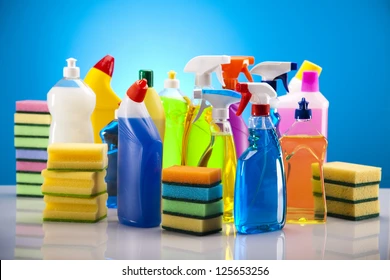
Cleaning material means a solvent used to remove contaminants and other materials, such as dirt, grease, oil, and dried or wet coating (e.g., depainting), from a substrate before or after coating application or from equipment associated with a coating operation, such as spray booths, spray guns, racks, tanks, and hangers.

All-purpose cleaners are a blend of different cleaning agents for a wide variety of messes and some even help sanitize against germs.
Glass cleaner — Opt for a streak-free formula to clean your mirrors, windows and other glass with less effort. Tile and grout cleaner
A vacuum cleaner, also known simply as a vacuum, is a device that causes suction in order to remove dirt from floors, upholstery, draperies, and other surfaces. It is generally electrically driven. The dirt is collected by either a dustbag or a cyclone for later disposal.
A broom is a cleaning tool consisting of usually stiff fibers attached to, and roughly parallel to, a cylindrical handle, the broomstick. It is thus a variety of brush with a long handle. It is commonly used in combination with a dustpan.
A brush is a common tool with bristles, wire or other filaments. It generally consists of a handle or block to which filaments are affixed in either a parallel or perpendicular orientation, depending on the way the brush is to be gripped during use.
Toilet cleaners are chemical solutions designed specifically for cleaning a toilet bowl, usually in conjunction with a toilet brush.
Laundry detergent is a type of detergent used for cleaning dirty laundry. Laundry detergent is manufactured in powder and liquid
A squeegee or squilgee is a tool with a flat, smooth rubber blade, used to remove or control the flow of liquid on a flat surface. It is used for cleaning and in printing.
Stainless steel cleaner; Heavy-duty degreasing solution; Dishwashing liquid; Descaling solution; Air freshener; Carpet cleaner; Laundry detergent; Stain remover.
Soap is a salt of a fatty acid used in a variety of cleansing and lubricating products. In a domestic setting, soaps are surfactants usually used for washing, bathing, and other types of housekeeping. In industrial settings, soaps are used as thickeners, components of some lubricants, and precursors to catalysts.
A detergent is a surfactant or a mixture of surfactants with cleansing properties when in dilute solutions.
A sponge is a cleaning aid made of soft, porous material. Typically used for cleaning impervious surfaces, sponges are especially good at absorbing water and water-based solutions. Originally made from natural sea sponges, they are most commonly made from synthetic materials today. 195 Total